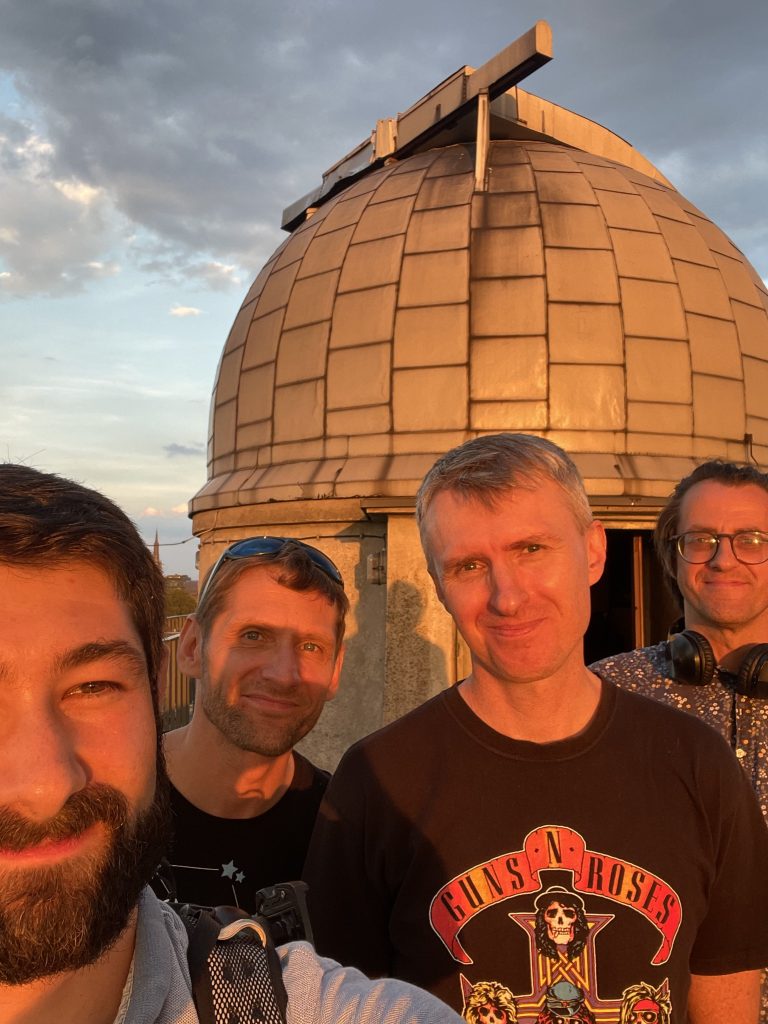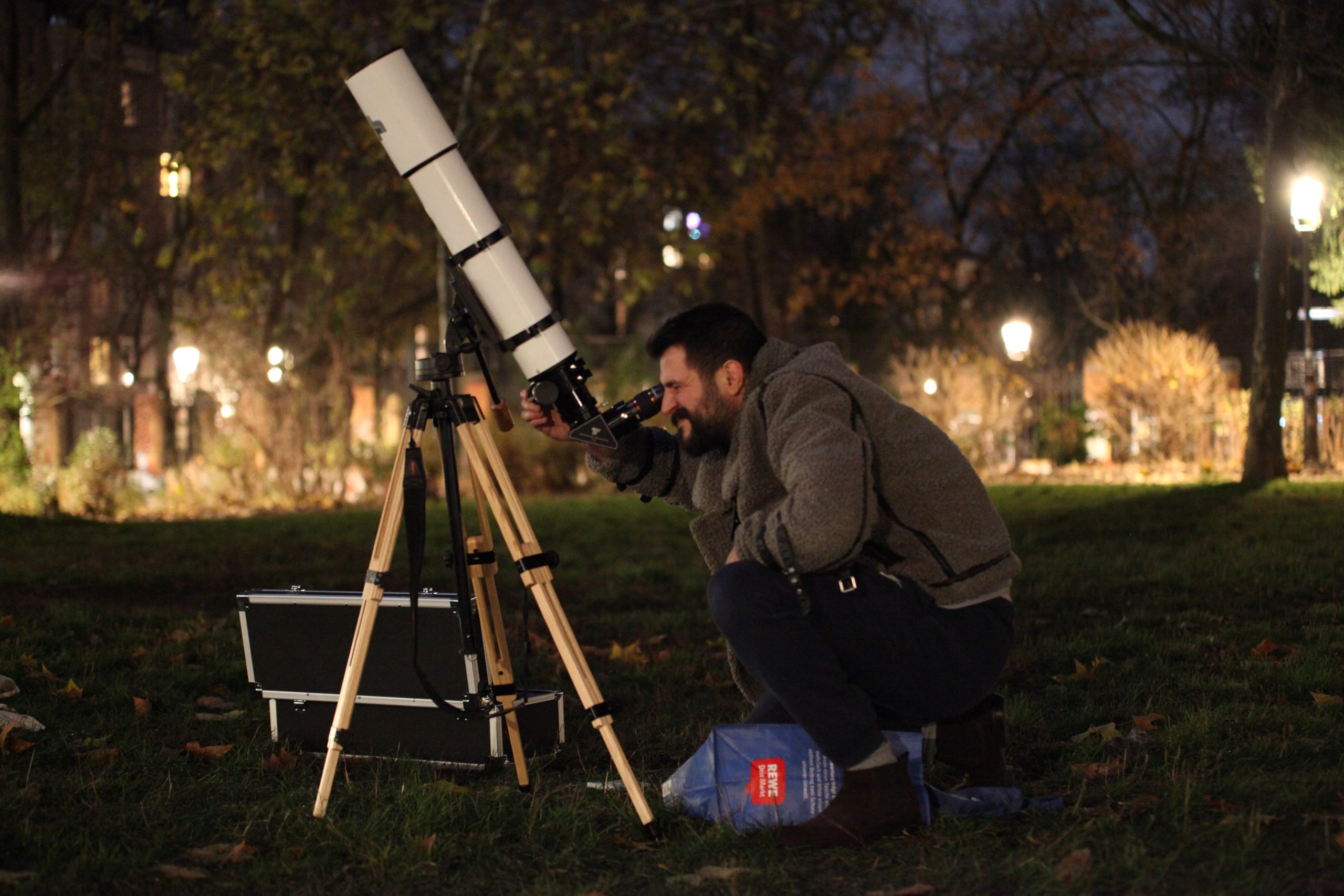
This week I visited the PTMA astronomy club in Szczecin. They’re a super active club with lots of enthusiastic members. What impressed me is the number of events they hold for the public.
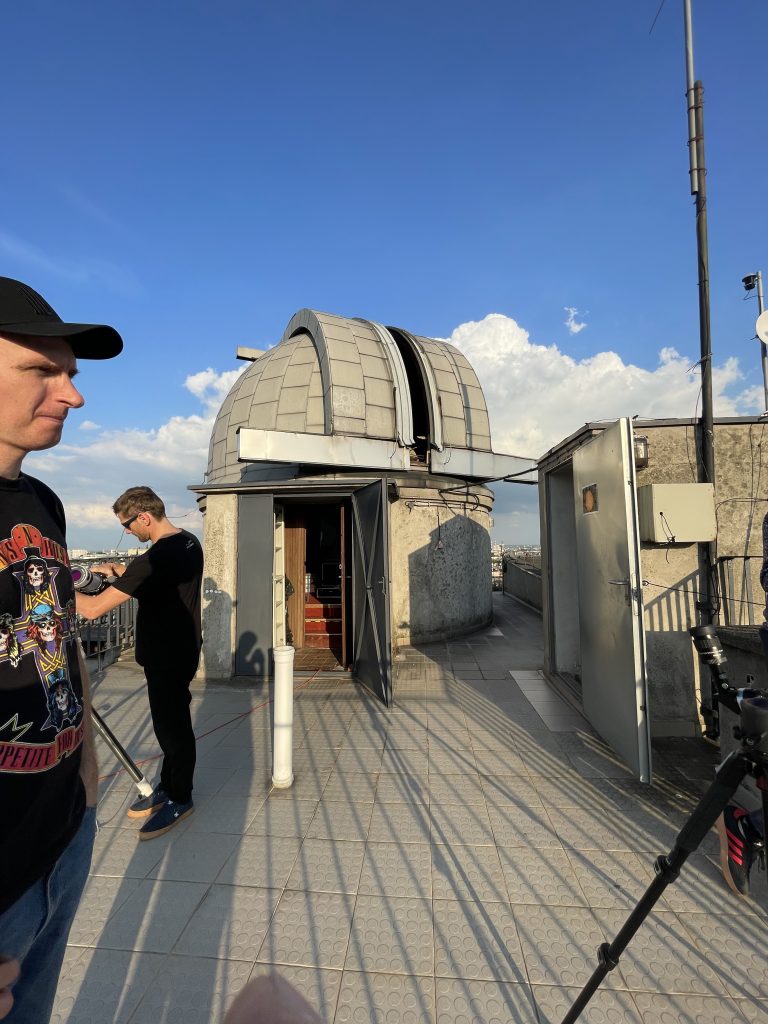
I walk up an eckish concrete building at the technical university.
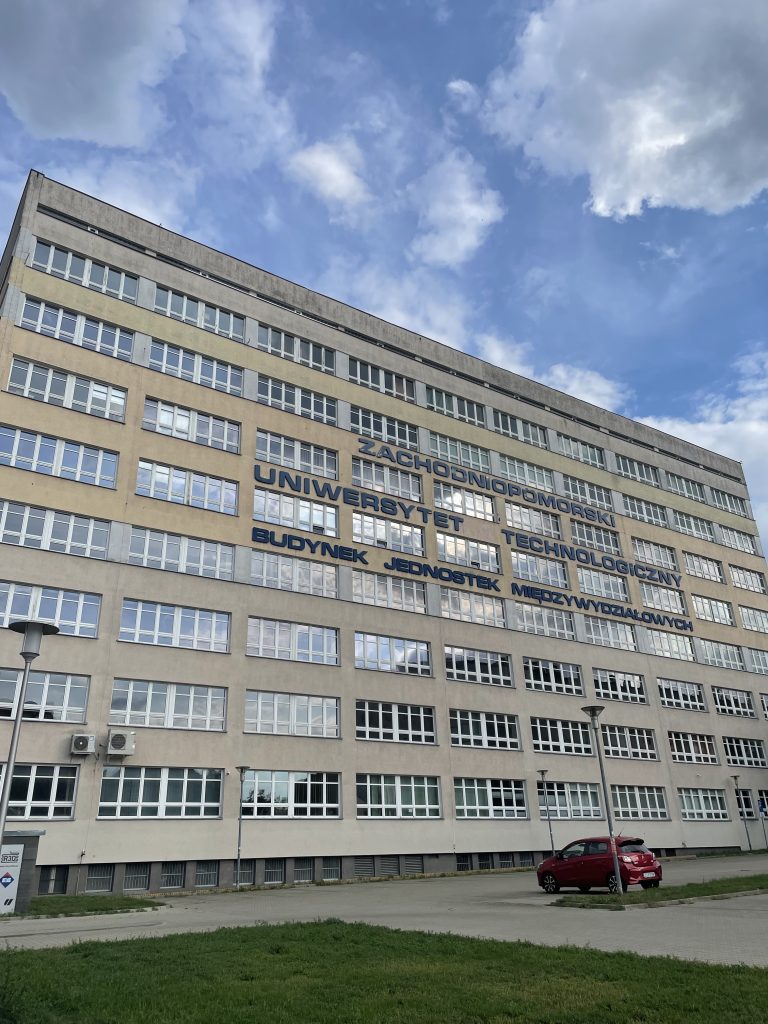
Marcin, my contact, says to call him when I arrive. Security is tight here.
Sure enough, a man approaches me with arms folded and asks something in Polish that I can’t understand. He’s insisting to know who I am and why I’m here.
I make a motion with a phone and say in desperation, “I’m calling, I’m calling him.”
I dial the number then look around. I see two men are walking towards me from the street. Marcin pulls his ringing phone out of his pocket and waves.
Marcin and Pawel greet me, we shake hands, and they bring me past the security guard. They show him two paper documents, and then they receive in return a set of keys to the observatory. We then step into an old elevator with riveted steel doors and a small window, allowing us to see the space inbetween floors.
This elevator is like a time machine, says Pawel.
We’re ascending into the past.
On the rooftop, we can see a vista of the entire city its church spires, the Oder River, and the forests stretching into the horizon. The sun glimmers down on the rooftops.
They get straight to work preparing the dome and the telescope. The observatory was built in 1986 to celebrate the 500th anniversary of Copernicus.
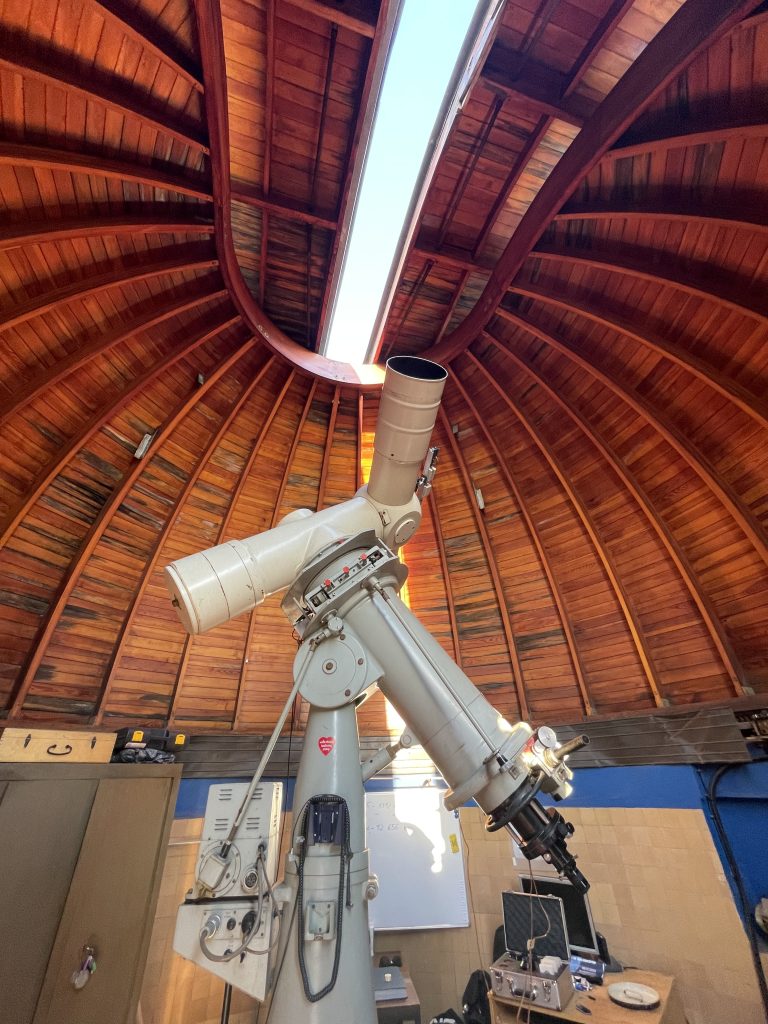
The dome is constructed of beautifully bent wood beams.
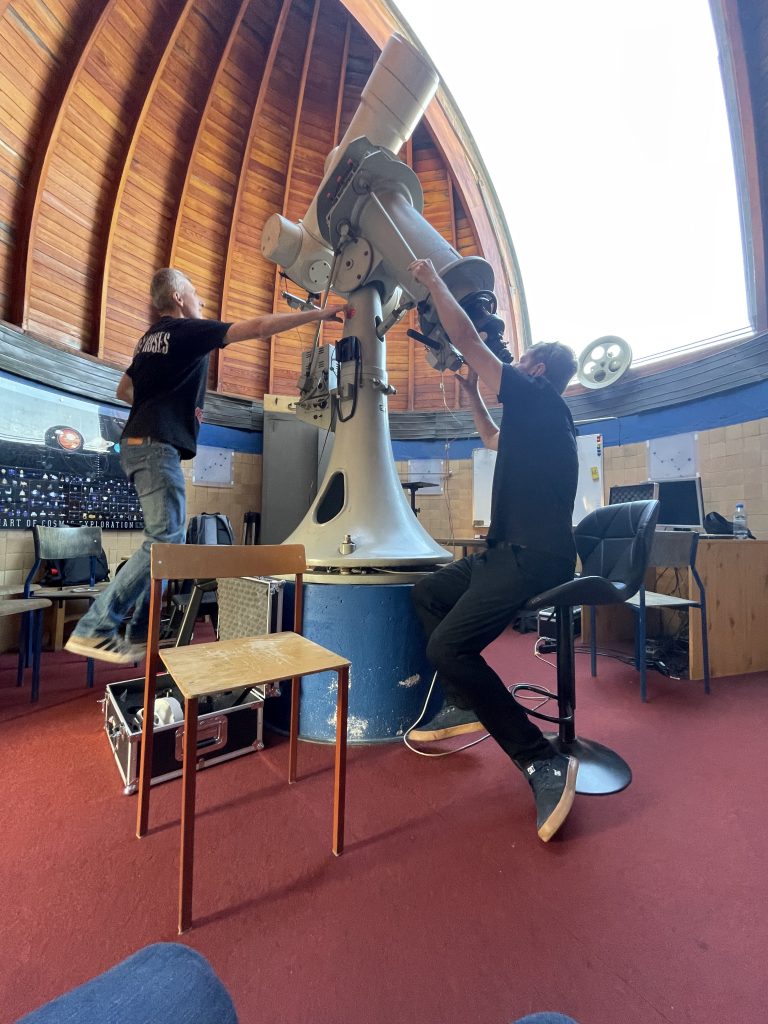
Inside, I find a special Zeiss telescope. It’s 15 cm diameter, and you can sit still in a chair while the telescope pivots. The eyepiece is fixed in one position and a series of mirrors relays the image to you, no matter where the telescope points. You optical engineers out there will realize that even with the mirrors, the image would still rotate. There has to be some kind of dove prism contraption to compensate the image rotation.
This design was produced from 1920 until 1995.
Imagine keeping a production line running for 70 years.
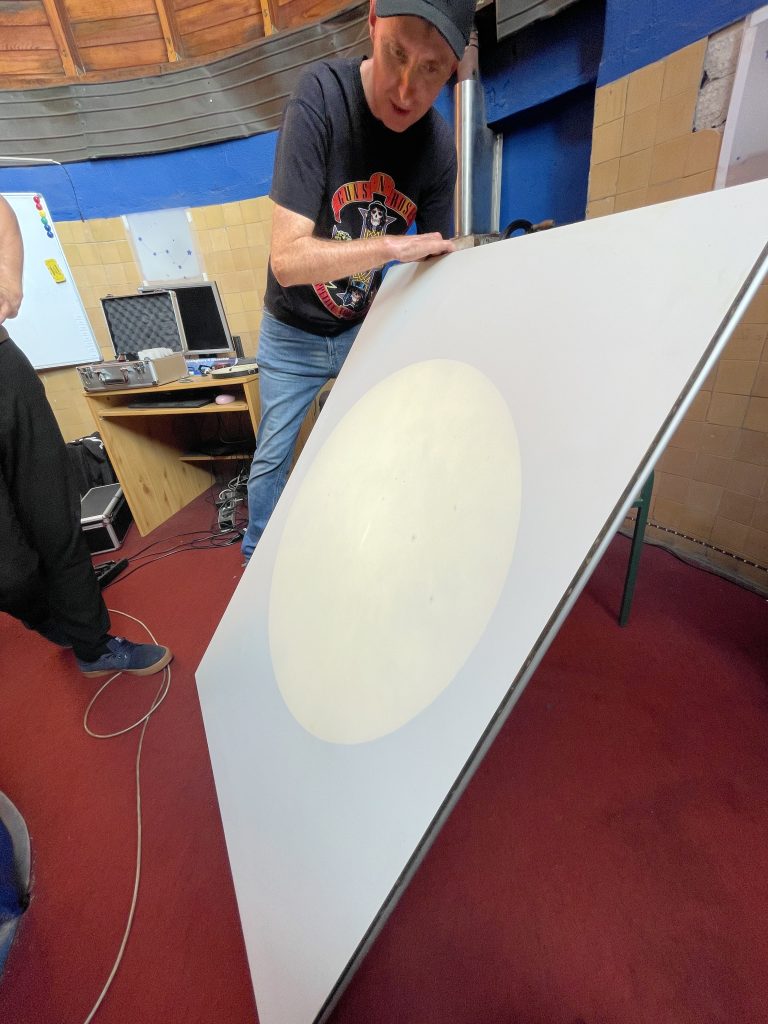
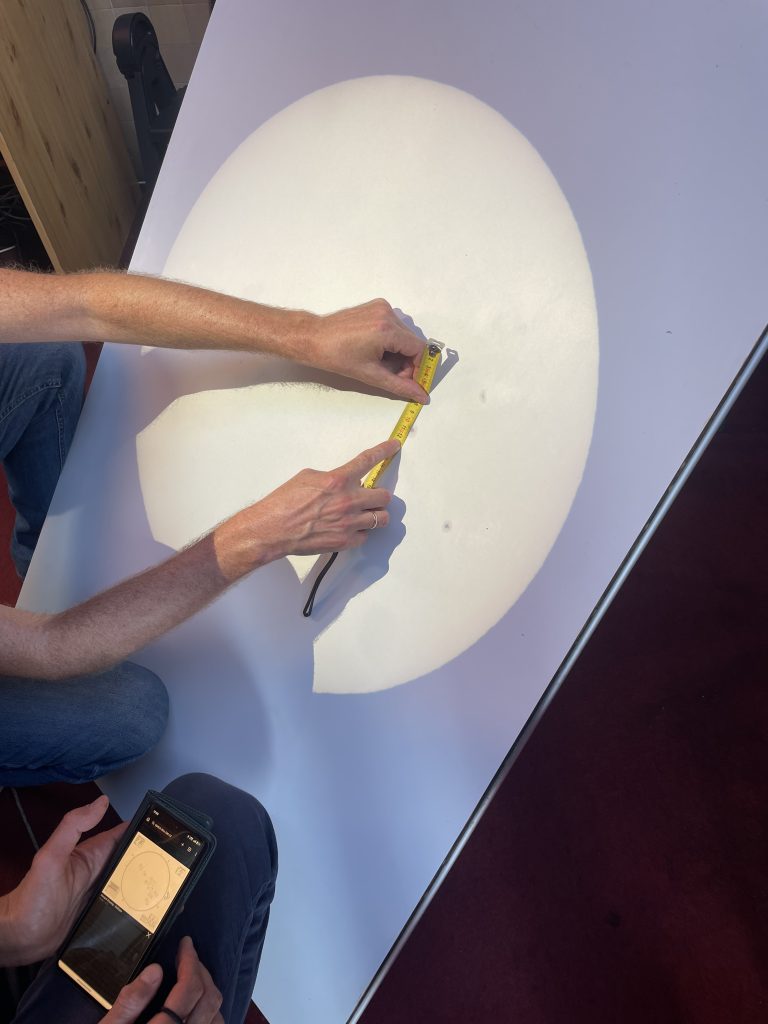
The astronomers point the telescope straight at the sun without a filter, and then pull a large white board out of a cabinet. They lean the board against a chair – aligning the image sensor, so to speak, and then close the dome down to a narrow slit. This is so that we can view the projection in a darker space.
A third astronomer, Lukasz, walks in at this point.
In the shadow, we can see a projection of the sun a meter across.
“Oh, how big is that sunspot today?”
“We can figure it out.”
Marcin takes a tape measure out of the closet and holds it up to the sunspot. Then he measures the diameter of the sun for scale. It’s an absurd exercise. The sun, so incomprehensibly massive that the Earth fits inside its electromagnetodynamic pimples. The sun, so powerful that it loses 4 million tons of mass a year and nobody notices. We’re putting a tape measure up it. Is it a delusion of grandeur to behold the cosmos in such a way? Or is it merely an illusion, and no image can capture the reality. To say the sun is the size of a million Earths is meaningless. We don’t even comprehend the size of one Earth.
The sunspot is 1 centimeter across. I smile.
A few calculations later, we see, that it’s 3 and a half Earths.
This club had lovingly restored the dome and telescope on their own time. When the University granted them access in 2014, the dome wouldn’t even close. The telescope had been exposed to rain and winter for years. Szczecin is extremely lucky to have an observatory in the city center.
For their efforts, the astronomy club has been struck with a new regulation from the university.
All buildings must close at lock at 21.00 – an existential threat to their club.
I’m saddened to hear. Even when dedicated volunteers are full of energy and ideas, new barriers emerge overnight. Why does it get harder and harder to offer astronomy to the public? Is it not the duty of a university to provide education to all who seek it?
“What if we all meet later in the street with our smallest telescopes?”
“I only have big telescopes”, says Marcin.
But the sky is 50-50. From the rooftop, we watch a large cumulonimbus cloud gaining strength to the north, and haze condensing in the east.
We resign ourselves to the weather forecast and make plans to meet again, maybe even in Berlin. We’re all enthusiastic about astronomy together. But today wasn’t feeling like the day. We close up shop and head back down the elevator.
“Floor zero, back to present day.”
We split up and I head for dinner. On my way back to my hotel, it starts to rain.
After dinner, the starry sky glimmers cloudlessly.
But I’m too tired – humans are not as immortal as the stars – we can’t expect to keep up!
Marcin, Pawel, and Lukasz, thank you for your generosity in hosting me.
I can’t wait to meet you on the street corner the next time I’m back!